
Amazon product images play a major role in how shoppers discover, evaluate, and understand your products. Your main image appears directly in Amazon search results, while additional listing images help shoppers examine details, understand size and features, and see the product in context.
Amazon also has specific product image requirements covering image size, resolution, background, file format, product placement, and what can — and cannot — appear in the main image.
This guide covers the key Amazon product image requirements for 2026, including recommended image dimensions, aspect ratio, zoom requirements, MAIN image rules, additional images, common mistakes, and using AI product photography for Amazon listings.
Amazon Product Image Requirements at a Glance
Every Amazon product needs at least one image, while Amazon recommends providing at least six product images and one video.
| Requirement | Amazon Guideline |
|---|---|
| Image size | 500–10,000 px on the longest side |
| Recommended size | 1,600 px or larger |
| Zoom | At least 1,000 px on the longest side |
| Resolution | At least 72 DPI |
| MAIN image background | Pure white — RGB 255, 255, 255 |
| Product coverage | At least 85% of the image frame |
| Preferred format | JPEG |
| Other accepted formats | PNG, TIFF, non-animated GIF |
| Aspect ratio | No specific ratio required |
Images should be clear, properly focused, and free from pixelation or jagged edges.
Amazon MAIN Image Requirements
Amazon calls the first image on a product detail page the MAIN image. It is especially important because it is also the product image shoppers typically see in Amazon search results.
The MAIN image has stricter requirements than additional listing images.
Pure White Background
The Amazon MAIN image must use a pure white background:
RGB: 255, 255, 255
Hex: #FFFFFF
Colored, gradient, lifestyle, or off-white backgrounds should not be used for the MAIN image.
Product Placement
The product should fill at least 85% of the image frame while remaining fully visible.
The image should accurately represent what the customer will receive. Avoid including unrelated props, accessories, or additional products that could create confusion about what is included in the purchase.
No Added Text or Promotional Graphics
Amazon MAIN images should not include added promotional elements such as:
- Marketing text
- Promotional badges
- Added logos
- Watermarks
- Borders
- Color blocks
- Background graphics
Text or branding that physically exists on the product itself is different from promotional graphics added to the image.

What Size Should Amazon Product Images Be?
Amazon accepts product images between 500 and 10,000 pixels on the longest side, but sellers should generally avoid targeting the minimum.
Images need to be at least 1,000 pixels on the longest side to support Amazon's zoom functionality. Amazon's current product photography guidance recommends 1,600 pixels or larger for optimal results.
Images should also have a resolution of at least 72 DPI.
Higher-resolution images are particularly useful for products where shoppers may want to inspect materials, textures, finishes, connectors, stitching, or other small details.
What Is the Best Amazon Product Image Aspect Ratio?
Amazon does not require a specific aspect ratio for product images.
A square 1:1 aspect ratio is commonly used in ecommerce product photography and can be a practical choice, but it is not an official Amazon requirement.
Other aspect ratios can be used as long as the image meets Amazon's size and content requirements. Amazon may add white padding when image proportions differ from the available display area rather than distorting the original image.
For the MAIN image, the priority should be keeping the product large, clear, and properly positioned within the frame.
Amazon Product Image Formats
Amazon prefers JPEG (.jpg or .jpeg) files.
It also accepts:
- PNG
- TIFF
- Non-animated GIF
Regardless of format, images should be sharp and free from visible pixelation or jagged edges.
For most sellers, a high-quality JPEG is the simplest option.
How Many Product Images Should You Use on Amazon?
Amazon requires at least one product image and recommends providing at least six images and one product video.
Instead of focusing only on filling available image slots, each image should have a clear purpose.
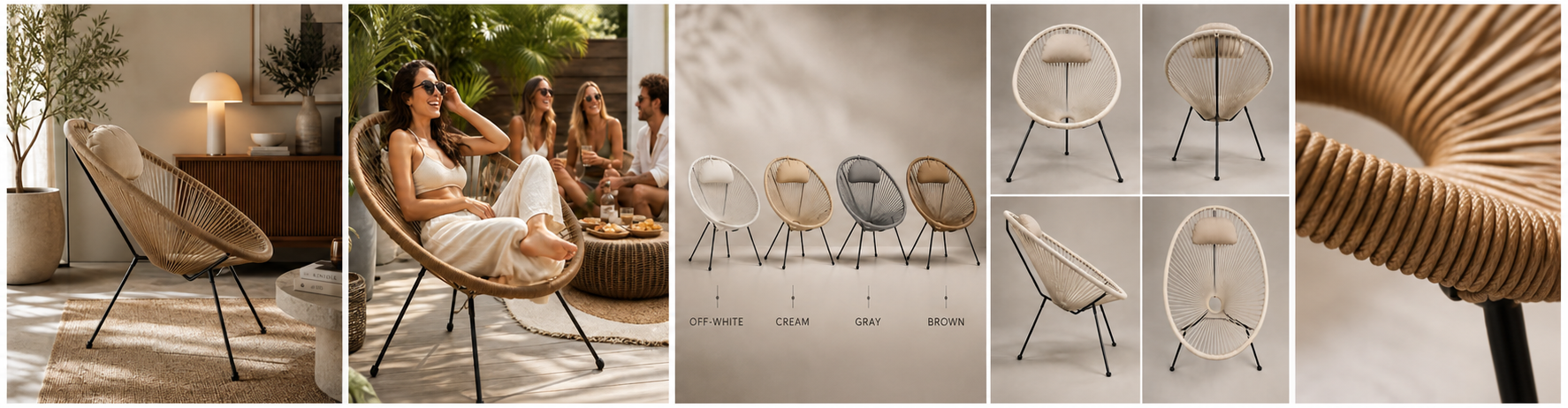
A strong Amazon listing image set can answer different questions a shopper may have before purchasing: What does the product look like from different angles? How large is it? How is it used? What details or features are important?
What Should Additional Amazon Listing Images Include?
Additional images provide more flexibility than the MAIN image. Amazon recommends using them to show the product in use or in an appropriate environment, from different angles, and to highlight different features.
Lifestyle Images
Lifestyle product photography shows the product in a realistic environment or use case.
For example, a kitchen product can be shown in a kitchen, outdoor equipment in an outdoor setting, or a bag being carried.
The goal is to help shoppers understand how the product fits into real-world use.
Different Product Angles
Use additional images to show areas that cannot be seen in the MAIN image, such as the back, sides, top, controls, ports, handles, openings, or other relevant details.
Close-Up Images
Close-ups can highlight materials, textures, construction, stitching, buttons, connectors, finishes, and other details shoppers may want to inspect.
Product Infographics
Infographics can highlight features, specifications, functionality, or other information that would not be appropriate on the MAIN image.
Size and Dimensions
A dimensions image can show exact measurements, while a scale or lifestyle image can help shoppers understand the product's real-world size.
Amazon Product Images and Zoom
Amazon's zoom functionality lets shoppers inspect product details more closely.
Images need to meet Amazon's minimum dimensions for zoom, which is another reason to avoid uploading the smallest technically accepted image size.
Zoom is particularly useful for products where details matter, including clothing, accessories, electronics, tools, jewelry, and products with distinctive materials or finishes.
MAIN Images vs. Additional Images
The MAIN image and additional images serve different purposes.
The MAIN image identifies the product clearly while following Amazon's stricter presentation requirements.
Additional images can explain and sell the product visually through environments, different views, details, dimensions, and supporting information.
A useful image sequence should progressively answer customer questions rather than repeat nearly identical views of the product.
Common Amazon Product Image Mistakes
Using the Wrong Background
A background that looks white may not actually be pure white. For the MAIN image, Amazon specifies RGB 255, 255, 255.
Making the Product Too Small
The product should occupy at least 85% of the frame. Excessive empty space can make the product appear unnecessarily small, particularly in search results.
Adding Text to the MAIN Image
Promotional text, badges, watermarks, and graphic callouts belong in additional images rather than the MAIN image.
Uploading Images That Are Too Small
Amazon accepts images below its recommended zoom size, but smaller images may not support zoom. Using sufficiently large images also gives shoppers a better opportunity to inspect product details.
Showing Items That Are Not Included
The MAIN image should not create confusion about what the customer receives. Contextual props are better suited to additional lifestyle images.
Repeating the Same Image
Multiple images provide little value if they all show nearly the same view. Use each image to communicate something different.
Category-Specific Amazon Image Requirements
Amazon's general product image requirements apply broadly, but some categories can have additional image and style rules.
This is particularly relevant to categories such as apparel, shoes, accessories, and jewelry.
Before publishing a listing, check the current requirements for your specific product category in Amazon Seller Central. Category-specific rules can change, so sellers should not assume that meeting the general image requirements is always sufficient.
Can You Use AI-Generated Product Images on Amazon?
AI product photography can make it faster to create ecommerce product images, but Amazon's image requirements and the need for accurate product representation still apply.
An AI-generated image should not change the product in a way that could mislead the customer. Avoid altering its shape, materials, color, components, functionality, or other important characteristics.
For the Amazon MAIN image, particular attention should be paid to product accuracy, the pure white background, proper placement, and prohibited promotional elements.
Additional images provide more creative freedom for AI-generated lifestyle scenes, product environments, infographics, close-ups, and other supporting visuals.
Creating Amazon Product Images with ListingSet
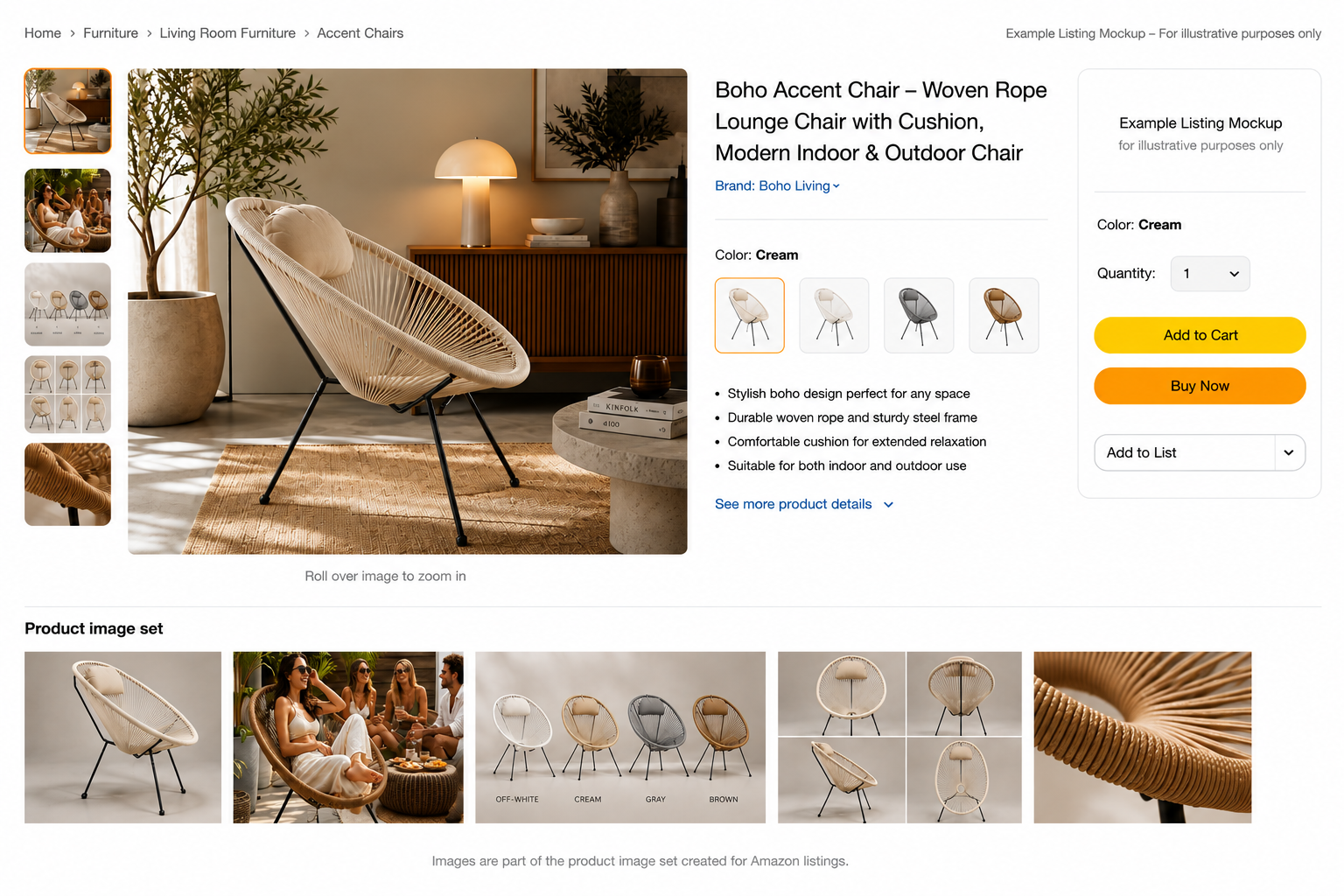
Producing a complete Amazon image set can involve several different assets: a clean MAIN image, lifestyle photography, different product angles, close-ups, infographics, and size visualizations.
ListingSet brings these elements into one workflow.
Upload reference images of your product, select Amazon as the target marketplace, and create a complete set of product listing images — including a main image, lifestyle scenes, different angles, close-ups, infographics, and size visualizations.
ListingSet can also generate an optimized product title and description, allowing sellers to create both visual and written components of an Amazon listing within the same workflow.
Amazon Product Image Requirements FAQ
Does Amazon require a white background?
Yes, for the MAIN product image. Amazon specifies a pure white background of RGB 255, 255, 255.
Additional images have more flexibility and can show the product in appropriate environments.
What size should Amazon product images be?
Amazon accepts images from 500 to 10,000 pixels on the longest side. Images should reach at least 1,000 pixels on the longest side for zoom functionality, while Amazon recommends 1,600 pixels or larger for optimal results.
What is the best aspect ratio for Amazon product images?
Amazon does not require a specific aspect ratio. Square 1:1 images are commonly used in ecommerce but are not an Amazon requirement.
Does the Amazon MAIN image have to be square?
No. Amazon does not require a square MAIN image.
How much of the image should the product fill?
The product should fill at least 85% of the image frame.
Can you put text on Amazon product images?
Added promotional text, logos, borders, watermarks, and similar graphics should not appear on the MAIN image. Additional images offer more flexibility for presenting product information.
What image format is best for Amazon?
Amazon prefers JPEG. PNG, TIFF, and non-animated GIF are also accepted.
How many Amazon product images should a listing have?
Amazon requires at least one image and recommends at least six product images plus one video.
Can you use AI for Amazon product photography?
AI can be used as part of the product image creation process, but the resulting images should accurately represent the product and follow the applicable Amazon image requirements.
Amazon Product Image Checklist
Before uploading your Amazon listing images, check that:
- Your MAIN image has a pure white background.
- The product fills at least 85% of the frame.
- The product is clearly and accurately represented.
- The MAIN image contains no added promotional text, watermarks, borders, or graphics.
- Your images are large enough to support Amazon zoom.
- Your files use an Amazon-supported format.
- Additional images provide useful new information rather than repeating the same view.
- You have checked any category-specific requirements that apply to your product.
Meeting Amazon's image requirements is the foundation. A well-planned image set can then use the available space to show the product clearly, answer customer questions, and give shoppers the information they need to make a purchase decision.